
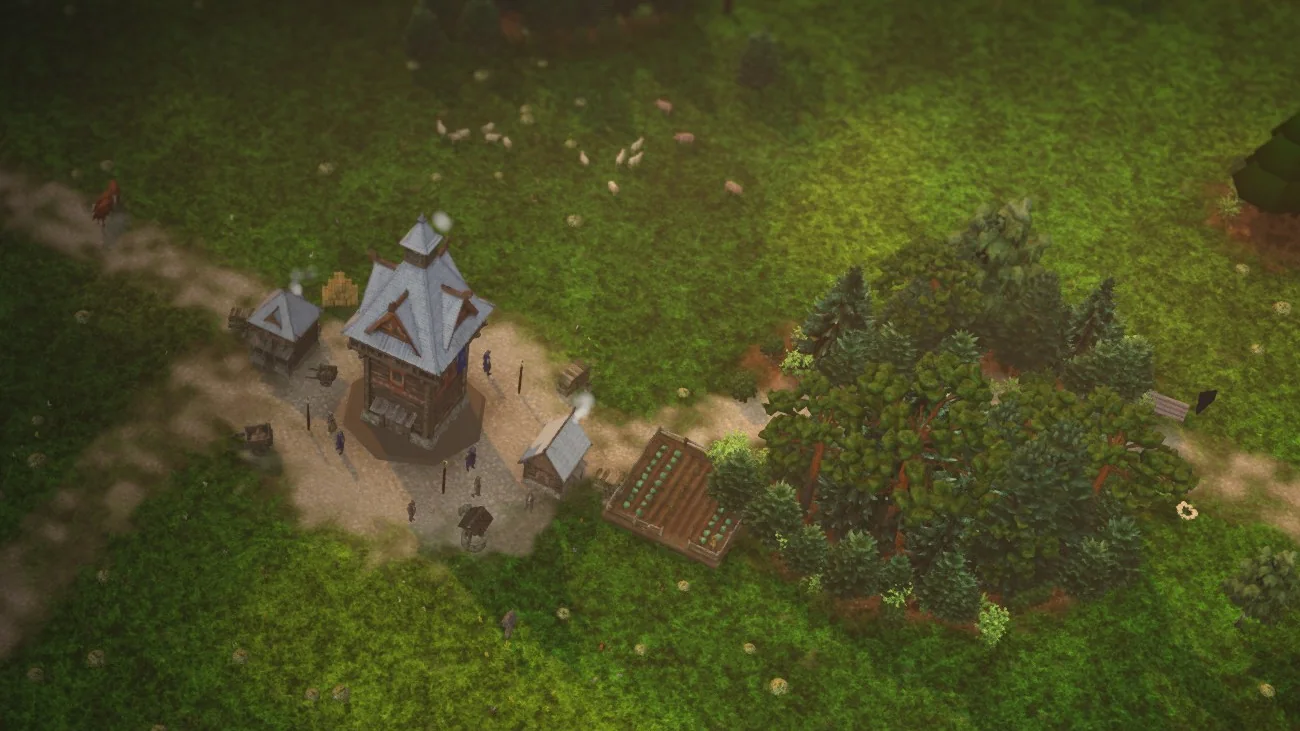
Every wall you draw changes how they get in tonight.
Medieval fort building and defence drawn from Slavic folklore. Days are untimed: you drag walls, roads and fields onto the grid and place towers and houses. Once night falls you can't build any more; as warden you give the orders and find out whether your design holds. A contract runs five nights, and the last one brings a boss.
- Genre
- Medieval castle building and defence
- Platform
- PC
- Status
- In development
- How to play
- Not public yet
- Built with
- three.js, TypeScript, Unity URP
Gameplay
Drop a wall, change the route
The red dashed line on the ground is the route the enemy will take tonight. Drag out a palisade, log wall or stone wall and you see the route bend before you let go; whole walls can be upgraded later.
Orders at night
Nothing new goes up after dark. The warden has orders instead: sound the horn to move the guard, loose a volley, pour hot pitch from the hoardings, open or shut the gate. Enemies go around, or pick the weakest stretch of wall and ram it.
Enemies out of folklore
Besides raiders and battering rams there are werewolf packs, forest fiends, night wraiths and swan-geese. On the last night Baba Yaga and her chicken-legged hut walk out of the forest; fight her, or follow the old custom and offer her hospitality.
When dawn comes
Dawn starts with the report: how many fell, where the wall broke, which villagers are missing. Then an event card turns, say the lord's recruiter riding up to take two of your people, and every answer has a cost.
Three wardens
Each new contract starts by choosing one of three wardens, each with an order of their own and their own way of talking.
Screens
Under the hood
The game runs on a deterministic simulation: same seed, same inputs, same result every time, and the renderer reads straight from it. Boss difficulty was tuned from automated players run across many seeds.
Rendered with three.js: bright days and dark nights, where enemies are picked out by moonlight, torches and braziers with no coloured markers by default; settings offer high, standard and low quality.
The look was first worked out in Unity URP with day and dusk lighting, and there was a Unity build playable through a full contract as well.
Buildings, enemies, trees and props are 3D models generated with Tripo AI through a pipeline we built ourselves: concept art to 3D, retopology down to a game-ready polygon count, rigging and animation, then automatic hole filling, texture cleanup and packing into game-ready GLB, with every piece reviewed in a close-up GPU render before it goes into the game. The whole list goes out with one command and resumes where it stopped without being charged twice; one round alone delivered 28 environment assets and 3 bosses. Anything meant to ship is generated with paid credits so the output rights are clear.
Next game
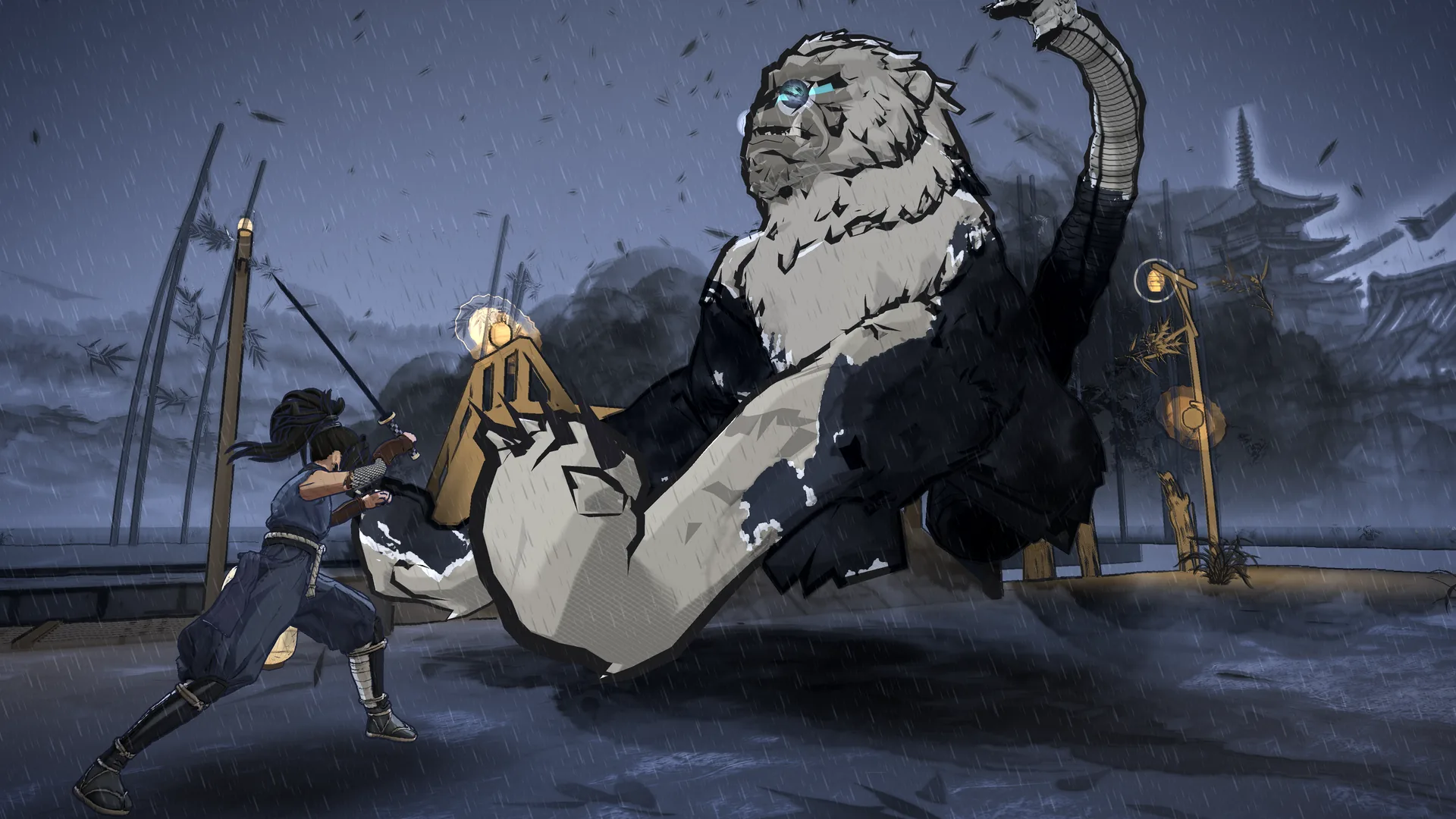
THE NIGHT PARADE百鬼夜行
White flash, deflect it. Red flash, dodge it.